
Showing posts with label Government Contract Compliant. Show all posts
Showing posts with label Government Contract Compliant. Show all posts
Monday, June 15, 2026
Making an Astute Bid/No Bid Decision
The elements of the process are discussed below in the form of questions to ask yourself against topics for key consideration. Affirmative or non-affirmative answers to the topical questions and ability to fill in the blanks below will drive your decision to bid or not bid a solicitation.
A. Customer:
Description:
Delivery Date:
Is this prospective contract for effort in which the company has strong skills? Yes____No ____
Carefully compare the competitive analysis under Item G to the win strategy under H before you make your final decision.


Wednesday, February 11, 2026
What is a "Compliant" Federal Government Services Contract Small Business System?

It seems the single word, "Compliance" in small business federal government services contracting business systems implies many different things:
- Small Businesses wish to know about compliance to assess the cost of doing business with the government, assure readiness and business system capability.
- Software Suppliers maintain they have compliant tools to achieve government contracting business management and wish to sell them.
- The Defense Contract Audit Agency (DCAA) has the mission to insure compliance with Cost Accounting Standards (CAS) under the Federal Acquisition Regulation.
- Defense Contract Management Agency Fact Finding Teams wish to observe small business systems to determine if an enterprise is capable of pricing, job cost accounting and billing consistency.
- Prime Contractors wish to know if a subcontractor is compliant with FAR and CAS so related flow down clauses can be made part of contractual agreements.
1. The business system is unique to the company, and recognizes the way the firm is organized and the way it manufactures or delivers products, supplies or services. Each company does business in a slightly different way, performs services or delivers products with organizations that function in various manners and yet all ultimately meet Modified US Government Cost Accounting Standards (CAS) objectives by live data demonstrating consistency with regard to cost allocation to contract objectives in pricing, job cost accounting, billing and closeout.
2. The business system meets Modified Cost Accounting Standard (CAS) Coverage defined by the government is as follows:
Standard 9904.401, Consistency in Estimating, Accumulating, and Reporting Costs Standard 401
Standard 9904.402, Consistency in Allocating Costs Incurred for the Same Purpose Standard 402
Standard 9904.405, Accounting for Unallowable Costs Standard 9904-405, Accounting for Unallowable Costs Standard 405 Unallowable Costs
Standard 9904.406, Cost Accounting Standard—Cost Accounting Period Standard 406
Modified, rather, than full, CAS coverage may be applied to a covered contract of less than $50 million awarded to a business unit that received less than $50 million in net CAS-covered awards in the immediately preceding cost accounting period.
The following article contains practical business system guidance regarding building a Modified CAS Coverage Small Business System for federal government contracting:
Managing Risk In Business System Development
Read the above government requirements and business system development guidance, and then give your selected method of business management the Modified CAS litmus test. Make a judgment that is the best for your company and try it out on DCAA. If they have problems with the approach you can adjust it.
The bottom line objective is that you wish government approval going forward so that your rates are accepted in proposals, your audits have a satisfactory outcome and you get paid when you submit a billing. Without those critical success factors the business cannot operate.
Tuesday, June 28, 2022
A FREE Companion Supplement to "Small Business Federal Government Contracting" Guidebook
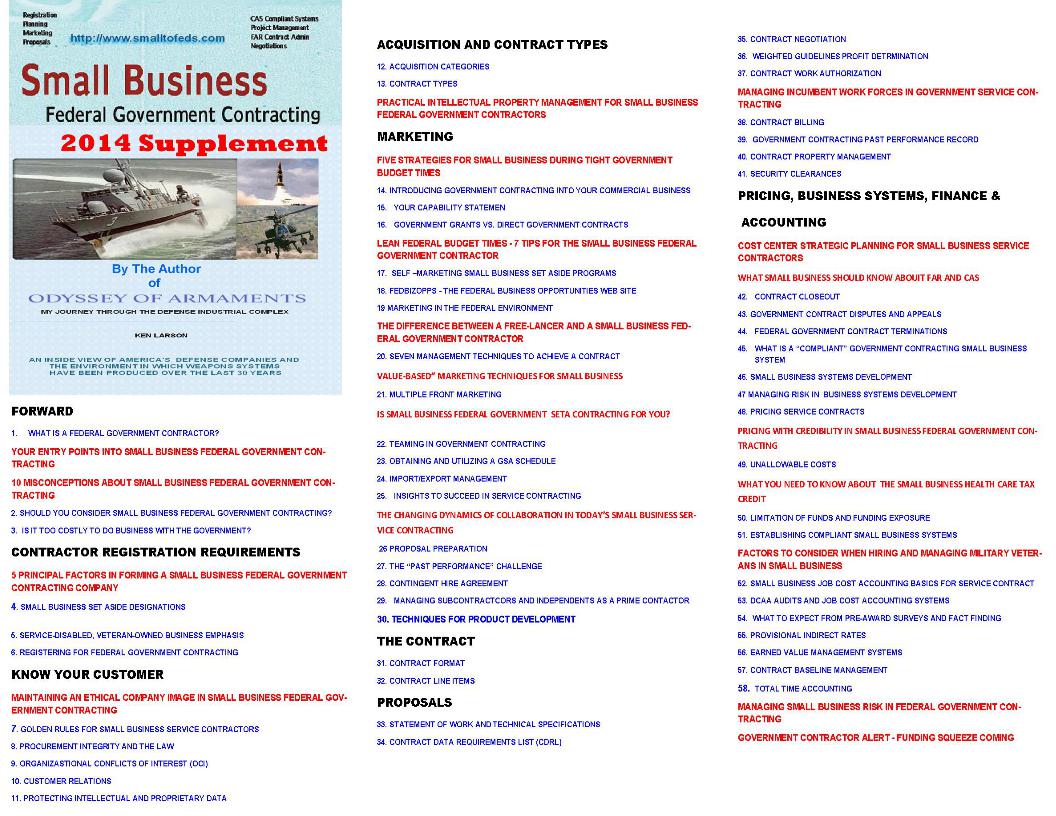
Please Click Above Image to Enlarge
We are pleased to offer this supplementary material free of charge to small business.
The basic guidebook has been available as a free download at this site and will remain so as a service to small business.
The supplement offers 19 additional topics.
Like the basic book, the supplement is a free download from the BOX cube in the right margin of this site.
Supplement topics are annotated in RED on the table of contents at the above illustration.
Although both the basic book and the supplement have been on the web for some time, the live links in both documents lead to the latest information on a given topic at this site.
Subscribe to:
Posts (Atom)